Review draft, not for circulation. Names, numbers and photo credits are still to be confirmed.
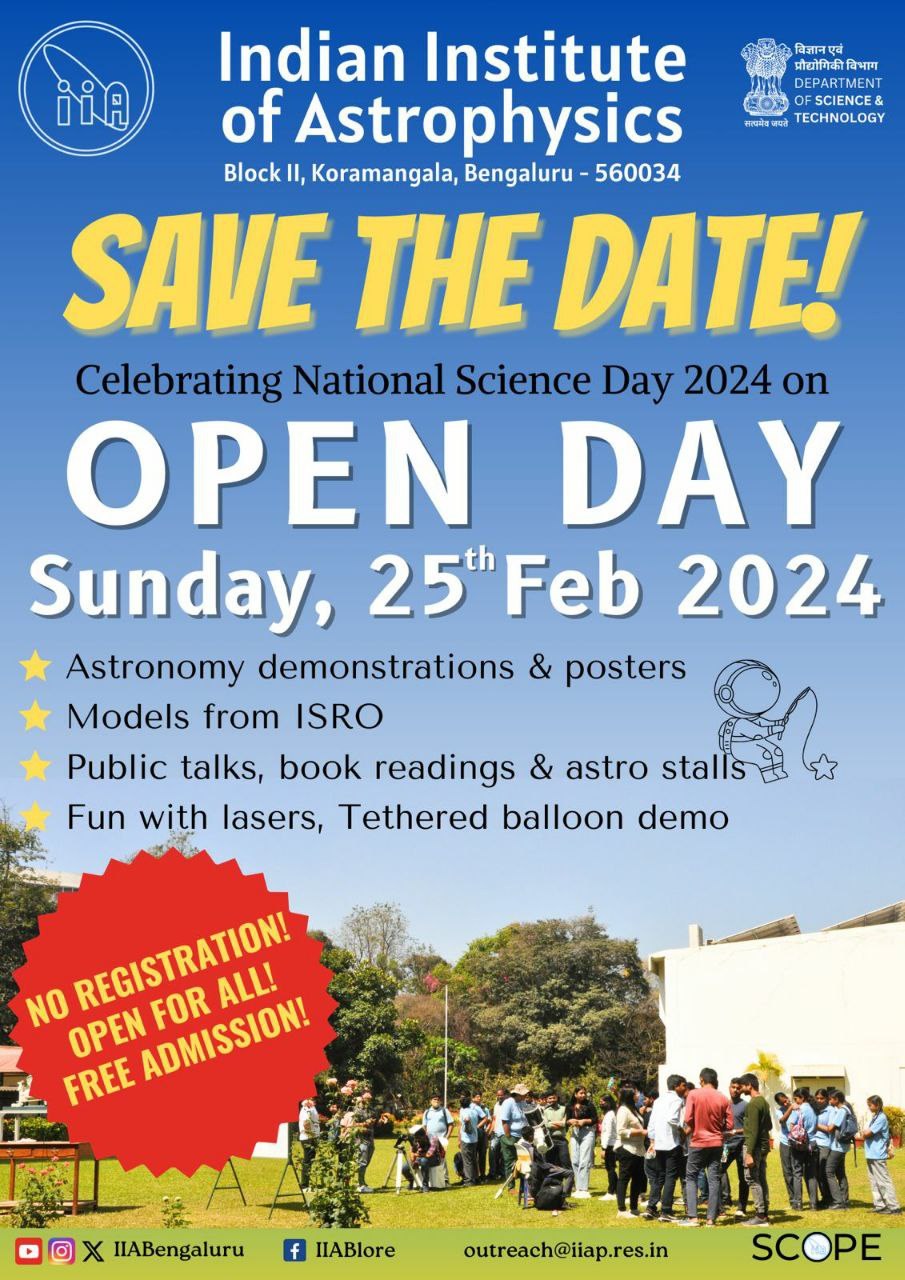
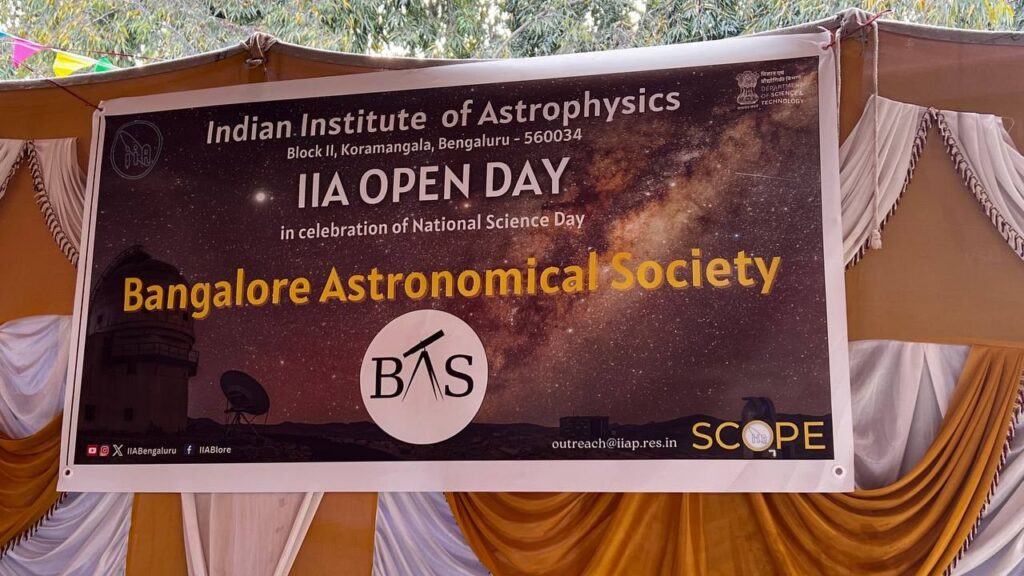
On Sunday, 25 February 2024, the Bangalore Astronomical Society (BAS) ran a stall at the Open Day of the Indian Institute of Astrophysics (IIA). IIA is a national research institute for astronomy and physics. It comes under the Government of India’s Department of Science and Technology. The Open Day was at its campus in Koramangala, Bengaluru.
IIA held the Open Day to celebrate National Science Day. India marks this day on 28 February each year. On that date in 1928, C. V. Raman announced the discovery that is now called the Raman effect.
Entry was free, and visitors did not need to register. BAS volunteers showed the Sun through telescopes. They also displayed members’ astrophotographs and showed 3D images of the Moon and the Sun. An astrophotograph is a photograph of an object in the sky.
The Open Day
IIA opened its campus to the public for the day. IIA’s poster listed this programme:
- astronomy demonstrations and posters;
- models from ISRO, the Indian Space Research Organisation;
- public talks and book readings;
- demonstrations with lasers, and a tethered balloon demonstration;
- astronomy stalls.
BAS ran one of the astronomy stalls.
The Sun, Up Close
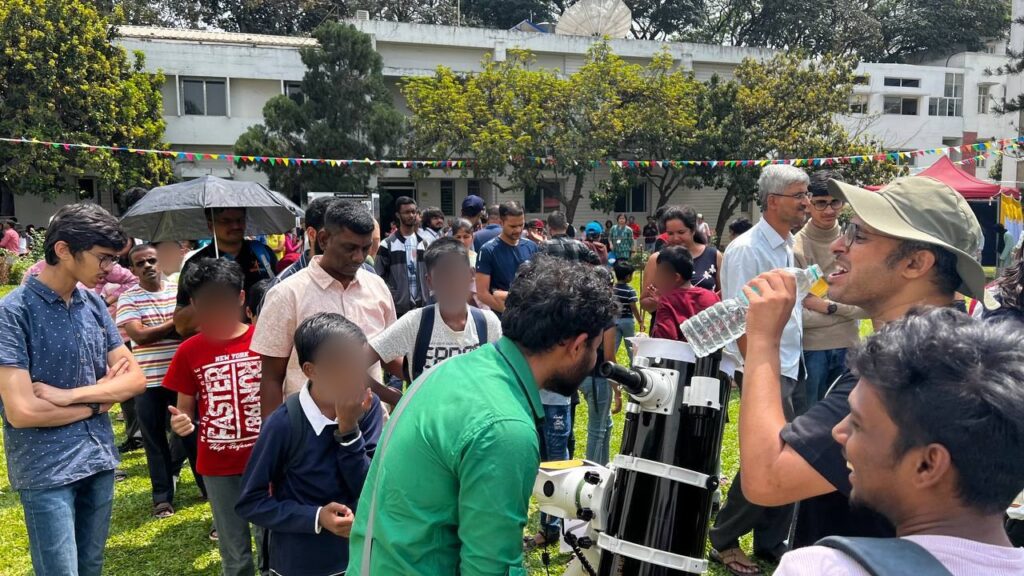
The Sun was the main attraction. BAS volunteers set up solar telescopes on the lawn beside the stall.
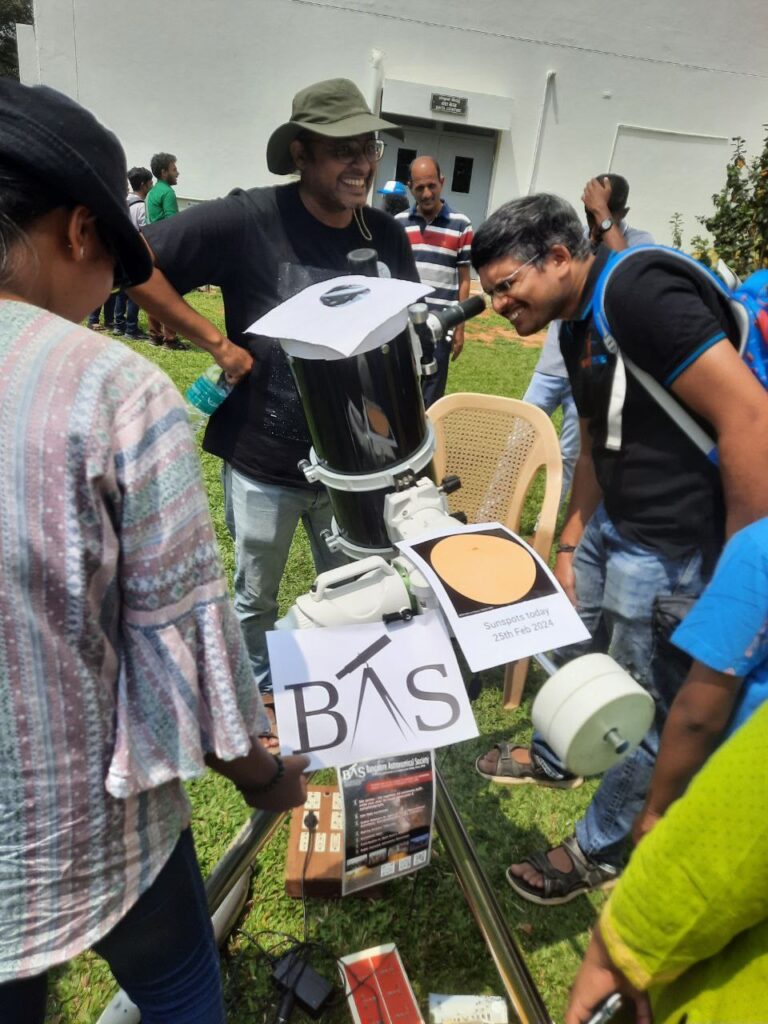
Never look at the Sun through a telescope without a proper solar filter. A solar filter blocks almost all of the Sun’s light and heat. Then the eye sees a safe, dim image of the Sun’s surface. Sunspots are cooler, darker areas on the Sun’s surface.
One station was a 10″ reflecting telescope with a GOTO feature. There was a sun filter attached to the telescope in order to make it save for observing the sun. The attendants watched the sunspots. A 25 mm eyepiece was used to get a full disc of the sun through the eyepiece.
A second station used a small Coronado solar telescope. With these telescopes, BAS showed visitors sunspots and prominences. Prominences are cool plasma, which in turn are ionized charged particles which follow the magnetic field lines of the sun.
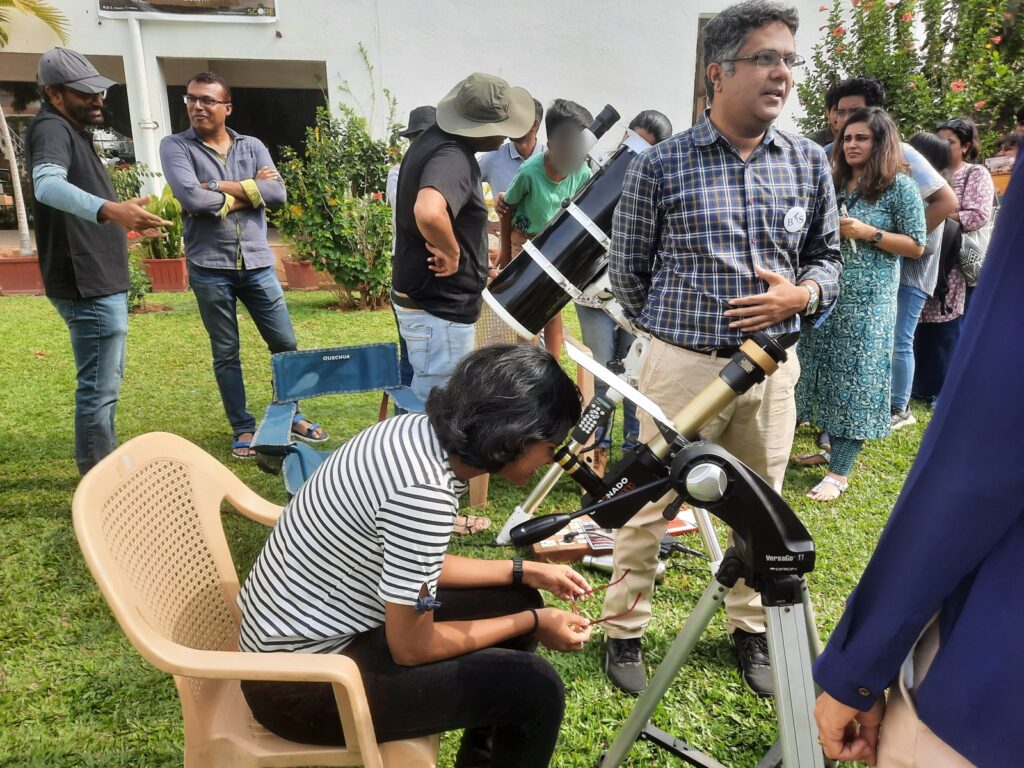
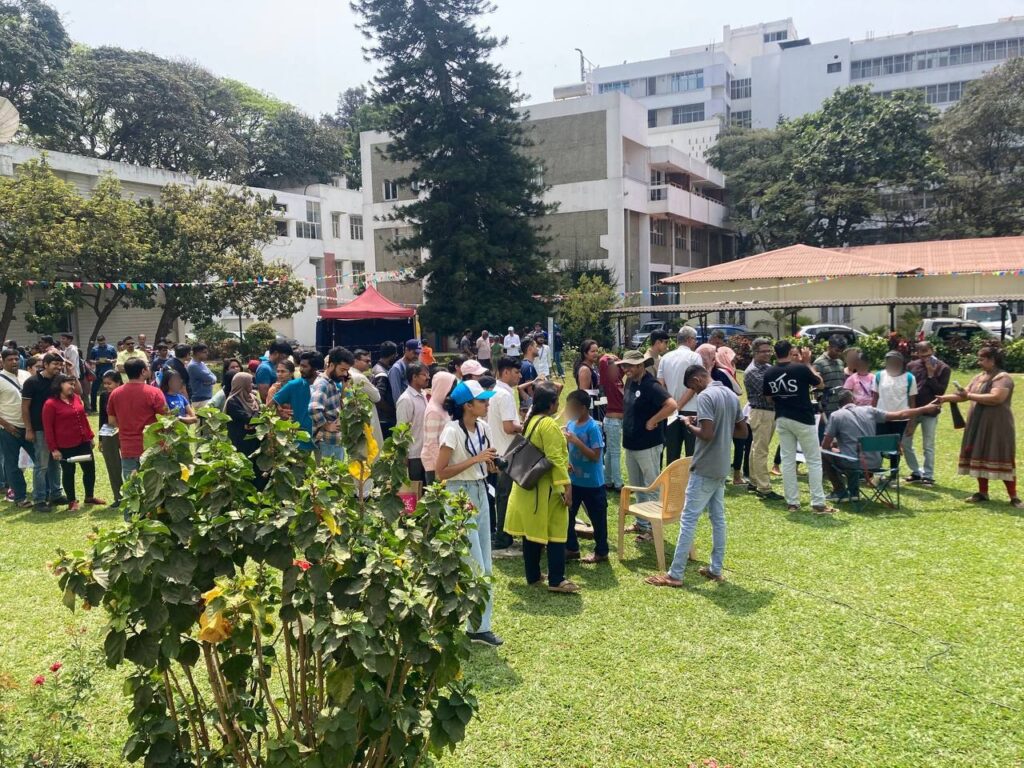
Long queues formed at the telescopes.
BAS estimates that more than 400 people looked at the Sun through its telescopes that day.
Pictures of the Sky
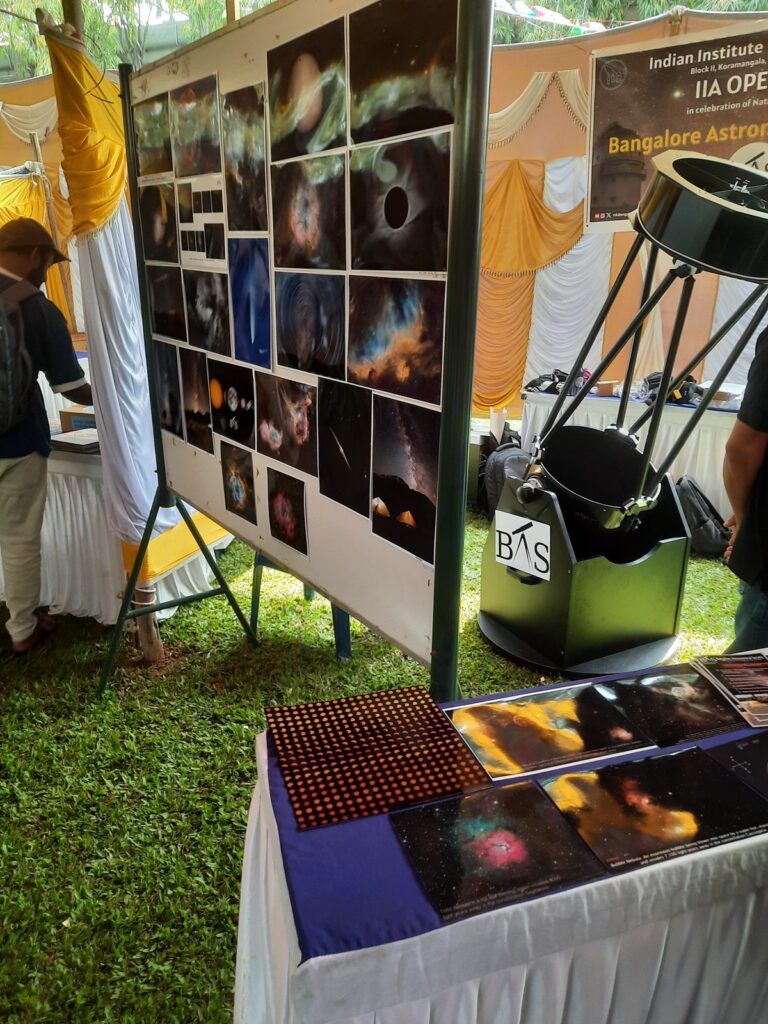
Inside BAS stall, BAS members displayed astro images which had been taken by them. The images included a total solar eclipse, nebulae and star trails. Nebulae are clouds of gas and dust in space. For a star trail photograph, the camera shutter stays open for a long time, so each star draws an arc. Other images showed the Milky Way over a dark site. More prints lay on the table.
A Dobsonian telescope with a BAS label stood beside the board. A Dobsonian is a simple reflecting telescope on a mount that turns by hand.
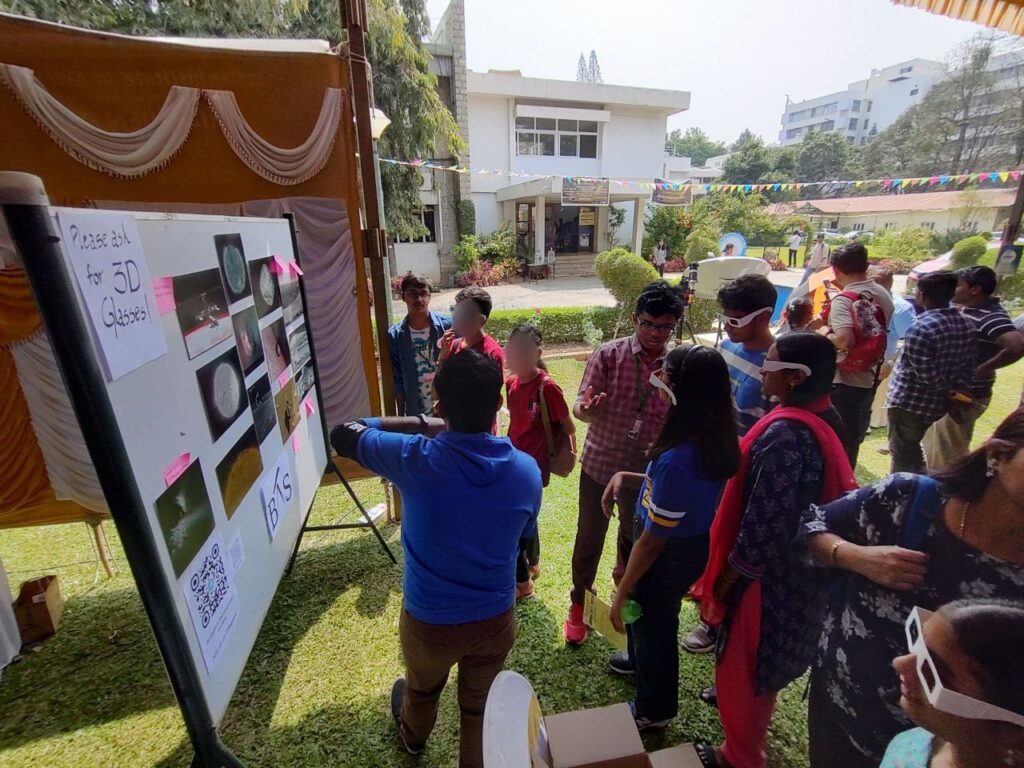
A second board showed 3D images, mostly of the Moon and the Sun. Some showed astronauts on the surface of the Moon. Visitors looked at the board through paper 3D glasses. The glasses send a slightly different view to each eye. The brain then joins the two views into one picture with depth. A sign on the board said “Please ask for 3D Glasses!”.
Meeting Visitors
Visitors who wanted to stay in touch could scan a QR code for the BAS Telegram group. A QR code was on the 3D display board. One volunteer wore a large BAS Telegram QR code on the back of his shirt.
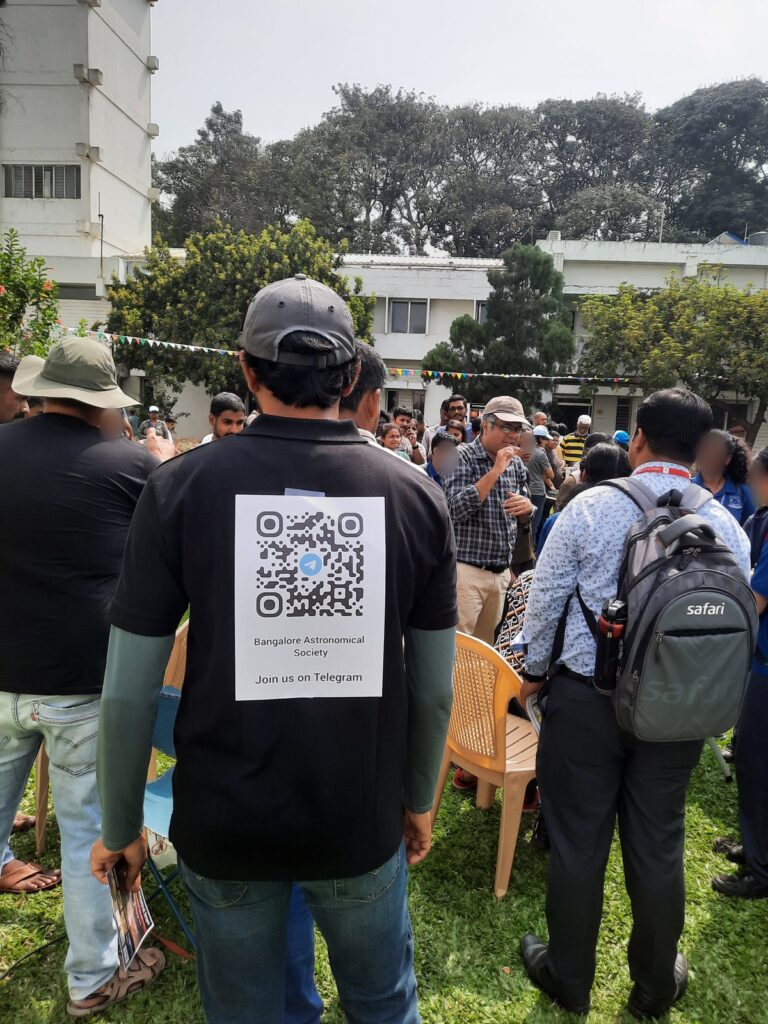
Visitors joined BAS: Astronomy Only, the BAS discussion group on Telegram, on the day and in the weeks after.
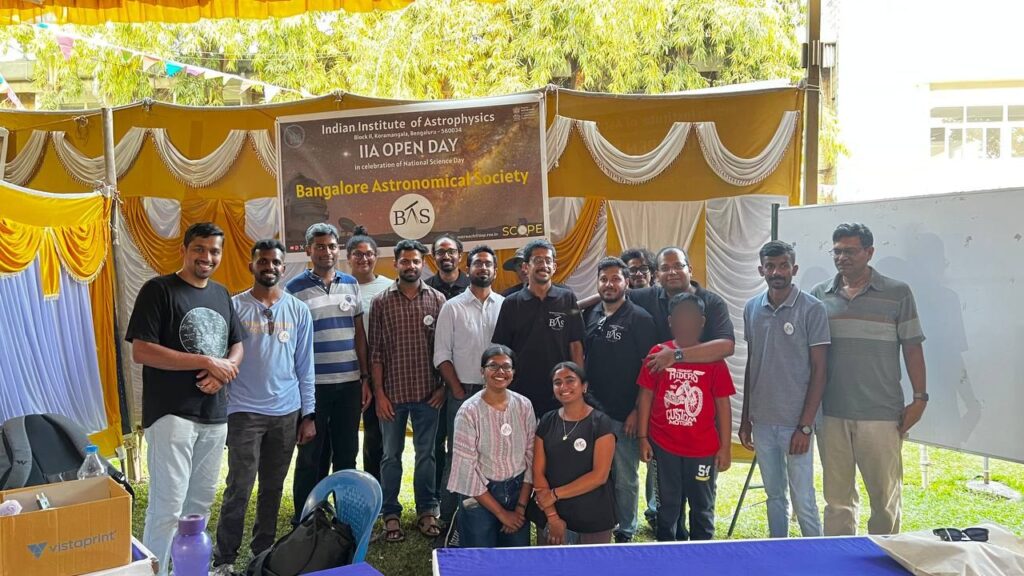
The BAS banner was up at the stall by about 08:00. Volunteers stood beside the telescopes to help visitors. Volunteers stayed with the telescopes past midday. Members also photographed the stall during the day.
During the day, BAS volunteers and members gathered at the stall for a group photograph.
Video of the Day
On 3 March 2024, BAS shared a video of the day: BAS at the IIA Open Day 2024.
How It Grew
In recent years, BAS has taken part in National Science Day events in Bengaluru each year since 2022. IIA took part in each of these events.
- 2022: on 27 February 2022, BAS took part in an online panel discussion, “Bengaluru: The Astronomy City”. Several Bengaluru astronomy organisations, IIA among them, held the panel together.
- 2023: on 25 February 2023, BAS had a stall at the Koramangala campus. Two solar telescopes showed sunspots and flares. By early afternoon, more than 300 visitors had seen the Sun. BAS also brought a large telescope with a 17.5-inch (44 cm) mirror.
- 2024: the stall showed the Sun, astrophotographs and 3D images. More than 400 people looked at the Sun.
- 2025: on 2 March 2025, BAS had a stall again.
- 2026: BAS had a stall again, on 21 February 2026.
Thank You
Thank you to the Indian Institute of Astrophysics and its outreach team for inviting BAS to the Open Day. Thank you also to all the BAS volunteers who showed the Sun to visitors and answered their questions.
BAS also holds star parties. A star party is a weekend of night-sky observing at a dark site, away from city lights. BAS announces each star party in its public groups.
To hear about the next IIA Open Day, BAS star parties and other events, join BAS: Astronomy Only on Telegram, or visit bas.org.in.